Keywords are the bridge between what someone types into Google and the page you published. Learning how to find low competition keywords matters more than chasing volume, because it decides which battles a site can realistically win.
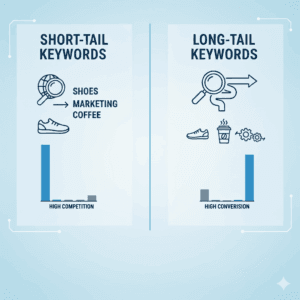
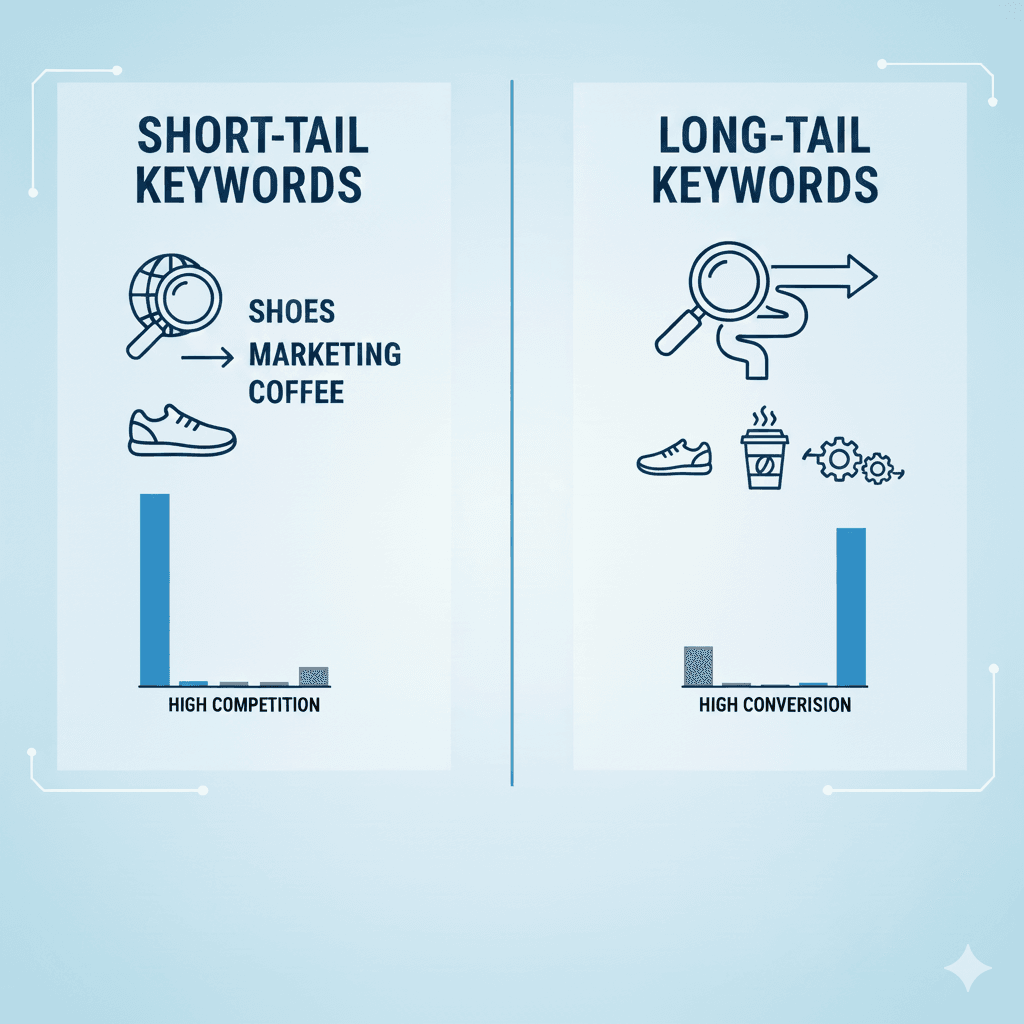
Not all keywords are equal. The split that counts most for a new or mid-sized site is between short-tail keywords, broad phrases of one or two words, and long-tail keywords, the longer and more specific ones. Almost everything about where a site can rank follows from that difference.
What follows covers what each type is, how they differ in practice, where to look for the ones you can win, and which to target first depending on how much history the domain has.
What short-tail keywords are
Short-tail keywords are short, general phrases, usually one or two words.
Examples:
- “shoes”
- “digital marketing”
- “hotels”
Characteristics:
- Search volume: very high.
- Competition: just as high.
- Intent: broad and unclear.
- Conversion: low, because nothing in the query says what the person wants.
Someone searching “shoes” might want to buy a pair, learn how they are made, or just look at styles. The query does not tell you which.
What long-tail keywords are
Long-tail keywords are longer, more specific phrases, usually three words or more.
Examples:
- “women’s leather boots in Portland”
- “how to build a digital marketing strategy step by step”
- “best all-inclusive resorts in Key West”
Characteristics:
- Search volume: lower.
- Competition: low to moderate.
- Intent: very specific.
- Conversion: high, because the person already knows what they want.
Someone searching “women’s leather boots in Portland” is probably ready to buy.
Long-tail vs. short-tail: the difference that matters
Side by side it looks like this:
| Aspect | Short-tail |
| Length | 1-2 words |
| Volume | High |
| Competition | Very high |
| Intent | Broad |
| Conversion | Low |
| Example | “marketing” |
The point: short-tail queries bring a lot of traffic that mostly is not qualified. Long-tail queries bring fewer visits, but visits much closer to becoming customers.

A concrete example
Say the business is web design:
- Short-tail: “websites”
- Long-tail: “restaurant website cost for small business”
With the first, you are competing against thousands of agencies worldwide. With the second, you are reaching a much narrower audience, often one with immediate intent to buy.
Which should you use in your SEO strategy?
The answer is not one or the other but how to combine them:
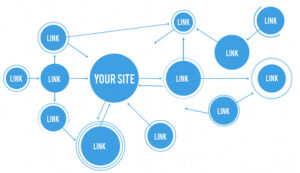
- Short-tail: to build authority — which in practice means earning links from sites that already have it — and appear for broad topics.
- Long-tail: to attract qualified traffic and generate conversions.
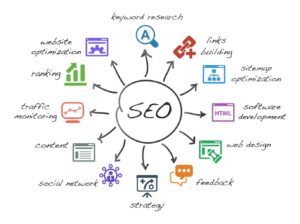
On a new project, starting with long-tail makes more sense. It ranks faster and brings in real customers, and the ground it wins is what makes the broader terms reachable later. Deciding which ones to chase comes from reading the actual search results, not from sorting a volume column, and from knowing which type of SEO work the site needs first.
How to find low competition keywords in practice
Four methods, in roughly the order worth trying them:
1. Google autocomplete
Start typing a query into Google and read the suggestions. They come from searches people actually make.
Type “digital marketing” and Google offers:
- “digital marketing for beginners”
- “digital marketing examples”
2. People Also Ask
The question box in the results is a direct source of long-tail phrasing, and it expands as you open each one.
3. SEO tools
- Ubersuggest – the easiest place to start.
- Ahrefs / Semrush – for deeper research and competitor data.
- AnswerThePublic – builds long-tail phrasing out of common questions.
4. Look at what competitors already rank for
Pull the keywords the leading sites in your category rank for, then look for the ones where they rank with a thin or outdated page. Those are the gaps worth taking, and they are the closest thing to a shortlist anyone will hand you.
How to use keywords on the page
Both types need to sit naturally in the content. The places that matter:
- Title (H1).
- Subheadings (H2, H3).
- The first paragraph.
- Meta description.
- Readable URLs.
- Internal links.
- Image alt text.
Avoid keyword stuffing. Repetition does not help, and a phrase forced into a sentence where it does not belong reads exactly like what it is.

Keywords that bring buyers instead of browsers
Not every keyword can sell, and the difference is intent rather than volume. “What is an ERP” is typed by someone learning; “ERP pricing for small business” is typed by someone buying. They can carry similar volume and be worth completely different amounts to a business.
Commercial keywords have recognizable markers. They contain a transaction word such as price, buy, quote, cost or hire, or they name a specific brand and model, or they include a constraint only a decided buyer bothers to add: a city, a size, a compatibility, a delivery window.
One group gets dismissed too early and is usually the most profitable: comparison queries, of the “X or Y”, “alternatives to X” and “X vs Y” kind. Anyone typing those has already accepted they will pay for something in the category and is only choosing a vendor. It is the closest point to the purchase that content can reach.
It is worth knowing which ones fail despite sounding commercial. Queries with “free” or “download” attract people who will not pay. Queries starting with “how to” attract people planning to do it themselves, which is exactly the profile that will not hire the service. Ranking for those is not an achievement; it is traffic that cannot convert.
The fastest way to tell them apart is to see who pays to appear. If a query shows several ads above the results, other companies have already verified with their own money that it brings buyers. It is the most reliable signal available and the cheapest to check: type the search and look.
One execution detail decides the outcome. A commercial keyword almost never belongs in an article; it belongs on a page. Someone searching with intent to buy expects a product, a price or a form, not a thousand words of explanation. Putting a commercial query in a blog post is the most common way to rank without selling anything.
For the content calendar, that means unbalancing it on purpose. Informational queries build the authority that makes competing for commercial ones possible, and commercial ones are what bring revenue. A site that only publishes the first kind ends up with a traffic chart that climbs and a phone that does not ring.
In local markets one modifier works as a commercial signal and gets overlooked: the place. “Accountant in Austin” or “uniform supplier in Charlotte” is typed by someone who wants to hire nearby, not by someone researching. Volume is small, competition sits far below the generic term, and the conversion rate does not resemble anything else in the account.
When the commercial query you want is out of reach because large brands hold it, the move is not to give up but to go one step narrower: add the constraint that limits the market, whether that is the place, the industry, the company size or the use case, and keep the slice you can win. It is less volume, and it is volume you can actually get. Which type of SEO work to run alongside it is the next decision.
Common mistakes
- Fixating on short-tail only. Hard to rank for and rarely profitable.
- Ignoring search intent. Someone searching “how to make bread” does not want an online store, they want a recipe.
- Chasing irrelevant keywords. If they do not line up with what the business sells, rankings change nothing.
- Never revisiting the content. A keyword’s relevance shifts over time, and so does what ranks for it.
A sequence that works in practice
A balanced approach tends to run in this order:
- Map long-tail keywords first – to bring in qualified traffic while the domain is still young.
- Optimize the main pages for short-tail terms – so authority accumulates where it will matter later.
- Build blog content around long-tail questions – answering the specific things the audience asks.
Then monitor in Search Console and whichever rank tracker you use, and adjust against what actually happened rather than what the volume estimates predicted.
The two types are not rivals, and the common error is treating the choice as permanent. A term that is out of reach this year may be reachable once a dozen long-tail pages have accumulated links, and a keyword that looked valuable can turn out to attract the wrong audience entirely. Both calls get revisited.
What does not change is the question worth asking of any keyword before writing for it: if this page reached the first position, could the people arriving buy anything? A surprising number of keyword plans fail that test, and no amount of optimization fixes it afterwards.
Which to target first on a new site
The theory says combine both. In practice, a site that just launched has an order forced on it.
A domain with no history does not compete for general terms, however good the content is. The first positions for those queries belong to sites with years of links behind them, and getting in takes months or years.
So the reasonable start is the specific end: concrete questions, use cases, product-and-place combinations. Each brings fewer visits, but they arrive in weeks and they arrive with clear intent.
As those pages accumulate signals, the domain gains weight and broader terms start to make sense. It is a sequence rather than a choice, because almost nobody reaches the general without passing through the specific.
There is one exception. If the business has a name people already recognize offline, searches for that name are short, carry volume, and can be won from day one. Those should be secured before anything else.
How to tell whether each type is working
Measuring both with the same yardstick leads to wrong conclusions, because they do not do the same job.
For specific terms, the useful indicator is conversion. If they bring few visits and none of them ends in an inquiry or a sale, the page is attracting the wrong person. For general terms, direct conversion will be low by definition, and judging them by it means abandoning content that is building recognition.
Worth looking at average position by group rather than as a single site-wide number. A site can be improving sharply on specific terms and sliding on general ones, and the average will show neither.
One more figure puts the rest in order: how many distinct pages receive any search traffic at all. If the total depends on two or three pages, the risk is high even when the headline number looks healthy.