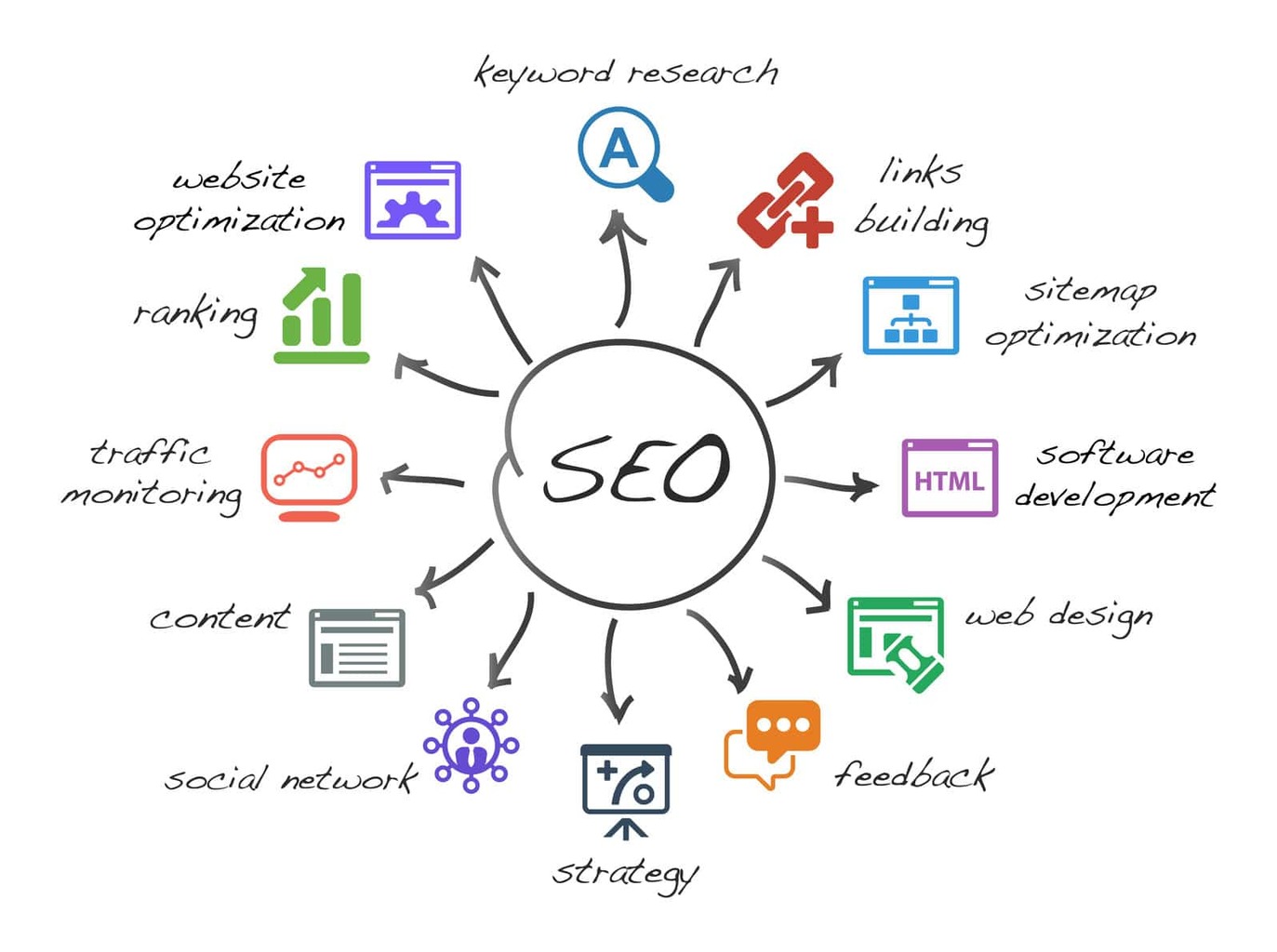
An SEO campaign is not one activity. It is several distinct disciplines that happen to share a name, and the order you run them in decides whether the work compounds or gets wasted.
On-page SEO deals with content and page structure. Off-page SEO covers everything that happens outside your domain. Technical SEO makes sure a search engine can reach and render the site at all. Each answers a different question, and each fails in a different way.
Beyond those three, specialisms have grown up around particular situations: local SEO, ecommerce SEO, international SEO, and more recently optimizing to be cited by AI assistants. Working out which of these a business actually needs is most of the planning.
What search engines are actually evaluating

SEO, search engine optimization, is the work of improving how visible a site is in organic results. In practice that means pages a crawler can reach, a parser can understand, and a ranking system has reason to prefer over the alternatives already in place.
The stakes are not theoretical. A site that does not appear on the first page for the queries its customers use does not exist to those customers. There is no partial credit in search results.
What counts as success has shifted. Ranking for isolated keywords is no longer the whole goal. Being cited by AI assistants such as ChatGPT and Gemini now matters, as does load speed that does not drive people away, and topical authority a search engine treats as legitimate rather than assembled.
So how do search engines judge a site? Not by counting links. It is a web of signals that includes real user behaviour and how consistent your information is across the rest of the internet. The E-E-A-T framework, meaning experience, expertise, authoritativeness and trustworthiness, carries particular weight in sensitive sectors such as health, finance and education.
That evaluation system is what everything below maps onto. Each type of SEO attacks a different part of it, which is why running them in the wrong order wastes money.
The three types every site needs
Three blocks form the base of any search work: on-page SEO, off-page SEO and technical SEO. Everything else is a specialisation layered on top, and a site missing one of the three cannot be rescued by doing more of another.
What each of the three covers
On-page SEO is everything you can change directly on your own site: the content itself, how keywords are used, how pages are structured. Off-page SEO covers external factors, principally the links pointing at you and how the brand is mentioned elsewhere.
Technical SEO deals with the layer underneath: load speed, sitemaps, crawl access, rendering. The split matters because each block fails independently, and working out which one is broken is faster than optimizing all three at once.
How they reinforce each other
These do not work in silos. A site with excellent content and broken technical foundations is a car with no engine. The relationship is sequential: technical SEO lets the content be indexed, on-page makes it relevant to a query, off-page gives a search engine a reason to trust it over someone else covering the same ground.
How to decide which one to start with
The deciding factor is the business model. A restaurant in Denver needs local SEO long before it needs an international strategy. A B2B software company should be working on content and AI visibility before it worries about a Google Business Profile it will never use.
The practical rule is to start with whichever type fixes the largest current leak of traffic or revenue. That sounds obvious and gets ignored routinely, because audits tend to produce a list of everything wrong rather than an order of operations.
| Type of SEO | What it covers |
|---|---|
| On-page SEO | Internal optimization of content and site structure |
| Off-page SEO | External factors affecting the site’s authority |
| Technical SEO | Back-end work that makes the site fast and crawlable |
On-page SEO: the part you fully control
On-page work is the only area of search where control is complete. Everything here is a decision you can make and ship today, which is why it is usually the cheapest place to find improvement and the first place worth looking.
Content, structure, keywords and metadata
Content is the spine of any site. It has to be relevant and it has to answer what the person actually asked. Structure matters nearly as much: H1, H2 and H3 tags organize the information for readers and tell a search engine the hierarchy of what it is reading.
Keywords need choosing carefully — the specific terms a site can win before the broad ones — and placing where they belong, in the title, the meta description and naturally through the text. The word doing the work in that sentence is naturally. A phrase forced into a sentence reads exactly like a phrase forced into a sentence, and ranking systems are now built to notice.
Navigation and user experience
User experience is not a separate discipline from SEO. Intuitive navigation lets people find what they came for, and a deliberate internal link structure does the same job for crawlers. Load speed belongs in the same category: a slow site frustrates people, and the behaviour that follows is measurable.
Images and video
Optimizing images and video goes further than adding alt text. Compress files without visible loss, use modern formats such as WebP, add transcripts for video, and mark the content up with the right schema. None of it is glamorous and all of it is measurable.
Off-page SEO: the signals you do not own
Off-page SEO covers everything that happens outside your domain and affects your visibility anyway. Control here is far weaker, which is precisely why it separates sites that rank from sites that merely deserve to.
Backlinks and link quality
Backlinks remain the most significant off-page factor, and they work as a vote of confidence. Which links are worth earning is the question that decides whether the effort pays. Quality overtook quantity long ago: one link from a recognized publication in your sector outweighs hundreds from generic directories, and the hundreds carry risk the one does not.
Social platforms and brand mentions
Social platforms are not a direct ranking factor, but they are where brand mentions and referral traffic start, and those produce signals a search engine does read. Unlinked mentions count as well; they feed into how relevant a brand looks on a topic, which is also how AI assistants decide who to cite.
Content marketing and outside collaborations
Publishing outside your own site, through guest articles in sector publications, podcast appearances or original data other people quote, builds authority that no on-page change can produce. The point is being cited, not the link by itself.
If a site has its on-page and technical work in order and still does not rank, off-page is almost always the missing piece. Without external signals, a search engine has no reason to prefer a new site over an established one covering the same subject.

Technical SEO: the foundation nobody sees
A site without sound technical structure is a building without foundations. Technical SEO is the set of changes to the site and the server that make it accessible to crawlers and tolerable to users. It is the one type where failure is absolute rather than gradual.
Core Web Vitals are the measurable part of that experience, and the thresholds are specific:
- LCP (Largest Contentful Paint) under 2.5 seconds for the main content to load.
- INP (Interaction to Next Paint) under 200 milliseconds for the site to respond to input.
- CLS (Cumulative Layout Shift) under 0.1 for visual stability.
Miss those thresholds and rankings suffer regardless of how good the content is. The XML sitemap is not optional either; it is the file that tells Google which pages you want indexed. Without one you are leaving a crawler to guess what exists on the site.
Sitemaps, schema and HTTPS
Schema markup in JSON-LD is what lets a page appear with rich elements in the results, such as star ratings, FAQs or product availability. In most competitive sectors it has stopped being an advantage and become a minimum.
HTTPS is no longer a bonus. Browsers flag sites still running on HTTP as not secure, which means people leave before the page has a chance. A secure site builds trust and removes a reason to go elsewhere.
Crawling, indexability and technical errors
Crawling and indexability are the heart of technical SEO. A misconfigured robots.txt can block the pages a site depends on, and nothing about the symptom points at the cause. Broken links and redirect chains erode authority quietly, which is what makes them worth checking on a schedule rather than when something has already gone wrong.
| Element | What it does |
|---|---|
| Core Web Vitals | Measures the experience of using the site |
| XML sitemap | Lists the pages you want indexed |
| JSON-LD schema | Structured data for rich results |
| HTTPS | Secure protocol for the site |
If the technical foundation is broken, everything else done on-page or off-page is irrelevant. It is the one dependency in search work with no way around it, and checking whether that foundation holds is exactly what a technical audit is for.
Local SEO: ranking in a specific place
A local business — or each location in a franchise network — lives or dies on whether it appears when someone nearby searches for what it sells. Local SEO is a narrower discipline than it looks, and it comes down to three levers.
The Google Business Profile
A complete, current Google Business Profile, formerly Google My Business, is the highest-return single action available to a local business. Accurate information, real photographs, correct hours. The bar is low and most competitors do not clear it.
Responding to reviews within a day makes a difference as well. Most people looking for a local service start on Google, and most of the clicks go to the three results in the local pack, where what is being ranked is the profile rather than the website.
Local keywords and NAP citations
Local keywords are not national keywords with a city appended. They name the city, the neighbourhood or the service area, and they often contain phrases such as “near me” or “open now” that never show up in a national keyword list. Research how a local customer actually types it.
Consistent NAP citations, meaning name, address and phone, across every directory and profile are the base of local trust. If Google finds the address written three different ways, it has reason to doubt the business exists as described, and that doubt shows up in the rankings.
Content for the local community
Content tied to the place works in a way national content cannot. Neighbourhood events, collaborations with nearby businesses, genuinely useful guides to services in the city: these establish a business as part of where it operates.
It also earns links and mentions from other local sites, which is the part most businesses miss. Local content is one of the few things that feeds local SEO and off-page SEO at the same time.
Content SEO: building topical authority
Content SEO is not about writing attractive articles. It is about planning what to publish, in what order, and how each piece links to the others. The pillar-cluster architecture is the working standard: one pillar page covering a broad subject, surrounded by cluster articles that answer specific questions inside it.
Done properly, that structure builds topical authority. Every piece connects to the others so a search engine can see the site covers a subject rather than mentioning it. Without the structure, articles compete against each other for the same queries, diluting whatever authority they would otherwise have built.
Editorial strategy and the pillar-cluster model
The pillar-cluster architecture gives each cluster article one specific sub-question to own. If the pillar is a complete guide to local SEO, the clusters cover things like optimizing a Google Business Profile or what NAP citations are. It helps a search engine understand the shape of the coverage, and it helps a reader find one answer without reading nine thousand words.
Writing for the intent behind the query
Useful content is not a slogan. Ranking systems actively demote text written to rank rather than to answer, and reward pages that address the search intent from the first line. If someone searches how to change a tire, the article opens with how to change a tire. No preamble, no history of the pneumatic tire.
Quality and keeping pages current
Content decays, and search engines notice when it has. Key pages need current figures, examples that still exist and links that still resolve. This is not optional polish; it is a recurring cost of having published anything, and it is the line item that gets cut first and hurts most.
| Element | What it is |
|---|---|
| Pillar page | Covers a broad subject thoroughly |
| Cluster articles | Answer specific related questions |
| Search intent | Content aligned with what was actually asked |
| Updating | Keeping published pages current |
Ecommerce SEO: when the catalogue is the problem
Online stores face problems a content site never encounters, and most of them come from scale. A catalogue of ten products needs none of what follows; a catalogue of ten thousand needs all of it.
Category architecture and faceted navigation
Category architecture is the spine of any store. With thousands of products, the way categories nest decides both whether a person can find anything and whether a crawler ever reaches the deeper pages at all.
Faceted navigation is useful and dangerous in equal measure. Filters for size, colour and price help shoppers, but left unmanaged they generate a near-infinite set of URL variants, each looking like a separate page. Canonical tags are what tell a search engine which version is the real one.
Product pages and product schema
Optimizing product pages goes beyond putting the name in the title. Descriptions need to be your own rather than the manufacturer’s copy, which every competitor is also using. Images need descriptive alt text, and the page needs product schema carrying price, availability and ratings.
That work improves the page for a reader and makes rich results possible at the same time, which is unusual. Most SEO tasks serve one audience or the other.
Google Merchant Center and the shopping surfaces
Feeding a catalogue into Google Merchant Center puts products in the Shopping tab and into search results with images, prices and ratings attached. Combined with correct schema, it produces a visual presence in the results that no conventional organic listing can match.
Ecommerce SEO is its own discipline for a reason: the failure modes are structural rather than editorial. A store can have excellent product copy and still be invisible because of how its filters generate URLs.
International SEO: more than one market
International SEO is what stops a site competing against itself across markets. If a business wants visibility in the United States, the United Kingdom, Canada and Mexico at once, it needs structural decisions made deliberately, not translated pages dropped into the same folder.
The first decision is the URL structure: a country-code domain, a subdomain or a subfolder. A ccTLD such as .de or .co.uk tells Google unambiguously that the content is for that country. Subfolders such as /en-gb/ are far easier to manage but send a weaker geographic signal. Subdomains sit in between and complicate measurement.
Choosing between ccTLD, subdomain and subfolder
There is no universally right answer. A ccTLD gives the clearest signal and the heaviest maintenance, since each domain accumulates authority separately and starts from nothing. Subfolders inherit the authority of an established domain, which usually makes them the pragmatic choice for a site that already ranks somewhere.
Implementing hreflang
hreflang is the tag that tells Google two pages are versions of the same thing for different languages or countries. Implemented correctly, it routes each visitor to the right version. Implemented incorrectly or not at all, the versions compete for the same queries and the stronger one suppresses the others.
Cultural adaptation, not translation
Adaptation goes well past translating the words. Prices in local currency, payment methods people expect, examples that exist in that market, measurement units nobody has to convert. A message that lands in London can read as irrelevant in Chicago, and the words were identical.
Done well, international SEO stops markets cannibalizing each other and lets each one reinforce the rest, because brand authority signals accumulate across all of them. Done badly, it produces several weak sites where there was one functioning one.
Voice and video: queries that are not typed
Spoken queries behave differently from typed ones, and the share of searches that arrive through an assistant or a video platform keeps growing. Both need the same thing from content, which is a direct answer near the top.
Conversational queries and voice assistants
Voice queries are longer and more natural. Instead of “italian restaurant”, someone asks “what’s the best italian restaurant near me”. Capturing those means answering specific questions plainly, in the sentence where the question is raised rather than three paragraphs later.
Featured snippets and FAQ schema raise the odds of being the answer that gets read aloud, because an assistant needs a passage it can lift intact. Content built in self-contained passages wins here; content built as a flowing essay does not.
Video SEO: titles, transcripts and video schema
Video SEO matters because a well-optimized video is discoverable on YouTube and in Google’s results at the same time. Descriptive titles carrying the main query do most of the work, and most uploads do not bother.
Transcripts are the underrated part. They make the content machine-readable, which is what allows a search engine or an assistant to quote it, and a two-minute video answering one concrete question often gets cited more than a long article on the same subject.
Visibility on multimedia platforms
YouTube is not a side channel; it is the second largest search engine in use. One optimized video can appear in YouTube results and in Google’s video results, which doubles the surfaces where it can be found without doubling the work.
The structural point is that multimedia content is now part of search rather than adjacent to it. A site that publishes only text competes on fewer surfaces than its competitors, whatever the quality of the text.
AI visibility (GEO): being the cited source
Generative engines have changed what visibility means. SEO for AI, also called GEO or generative engine optimization, is about being cited by tools like ChatGPT, Gemini and Claude. The goal is not a ranking position but being selected as a source when a model assembles an answer.
The tactics overlap heavily with conventional SEO but demand more precision. Clear claims, unambiguous entity information, structured data, and semantic consistency across the whole site, so a model reading three of your pages draws the same conclusion from each.
What SEO for AI actually means
In practice it means competing to be the preferred source in a generated answer rather than competing for a click. Those are different contests. A page can win the second and lose the first, and increasingly the first is where the question gets settled.
How to get cited by ChatGPT, Gemini and the rest
Concise content that answers a specific question does best. Models favour clear, direct passages, which means long introductions actively hurt. Use schema to structure the information and make each passage self-contained enough to be quoted without the surrounding paragraphs.
Measuring share of voice in AI answers
Measurement here is genuinely unsolved. The workable approach is tracking share of voice by keyword cluster across the main assistants: how often your brand appears when the question is asked, and who appears instead when it does not.
A site holding the first position in Google but absent from AI answers is losing informational traffic it has already earned the right to, and the gap is widening rather than closing. Nobody has a reliable figure for how much, which is itself a reason to measure your own rather than trust a published one.
Sequencing an SEO campaign for your business model
All of the above is a menu, not a plan. What turns it into a plan is deciding what comes first, and that depends almost entirely on the business model rather than on which discipline is most interesting.
A local services business should go technical first, then local, then on-page, then content, then AI visibility. The technical work comes first because nothing else is measurable until the site can be crawled, and local comes next because it is where the demand already exists.
An ecommerce store goes technical, then ecommerce-specific work on categories and product pages, then on-page, then content, then off-page. Getting the catalogue crawlable before writing anything is the order that avoids repeating work.
A B2B software company goes technical, then content, then on-page, then AI visibility and international. Content comes early because the demand has to be created rather than captured, and that takes longer than any other part of the plan.
What those three orders have in common is that technical comes first and the expensive, slow discipline comes before the one that depends on it. The most common planning error is not choosing the wrong type of SEO; it is choosing the right ones in an order where each has to wait for the previous one to finish. The overview of each type of SEO work sets out what that order depends on.
Frequently asked questions
What is SEO and why does it matter for a website?
SEO, or search engine optimization, is the set of practices that improve how visible a site is in search results. It matters because position determines traffic, and traffic determines how many business opportunities the site produces at all.
Which types of SEO should a site consider?
The three every site needs are on-page, off-page and technical. On top of those sit specialisms that apply to particular situations: local, content, ecommerce, international, and AI visibility. Which ones apply depends on the business model.
How do you optimize the content on a site?
Use the terms people actually search, answer the question in the first lines, structure the page with clear headings, and keep the content current. Updating existing pages usually returns more than publishing new ones.
How does load speed affect SEO?
Load speed is part of technical SEO and is measured through Core Web Vitals. A slow site frustrates people, which produces behaviour a search engine can observe, and missing the thresholds suppresses rankings regardless of content quality.
What is local SEO and how do you implement it?
Local SEO targets geographic searches. It comes down to a complete Google Business Profile, keywords that include the city or service area, consistent name, address and phone details across directories, and content tied to the community the business operates in.