
Drip marketing is the practice of sending a planned series of messages triggered by what someone does rather than by a date on a calendar. Someone downloads a guide, and the follow-up arrives over the next week without anyone sending it. That is the whole idea, and the reason it works is that it runs whether or not anyone is at the desk.
It is also the part of marketing most often oversold. The sequences themselves are simple; what makes them work or fail is the thinking before they are built, and no platform supplies that.
What follows covers how the triggers and conditions actually work, the three sequences worth building before any others, how to choose a platform without getting trapped in it, and what the setup looks like across a few industries.
What drip marketing is, and what it is not
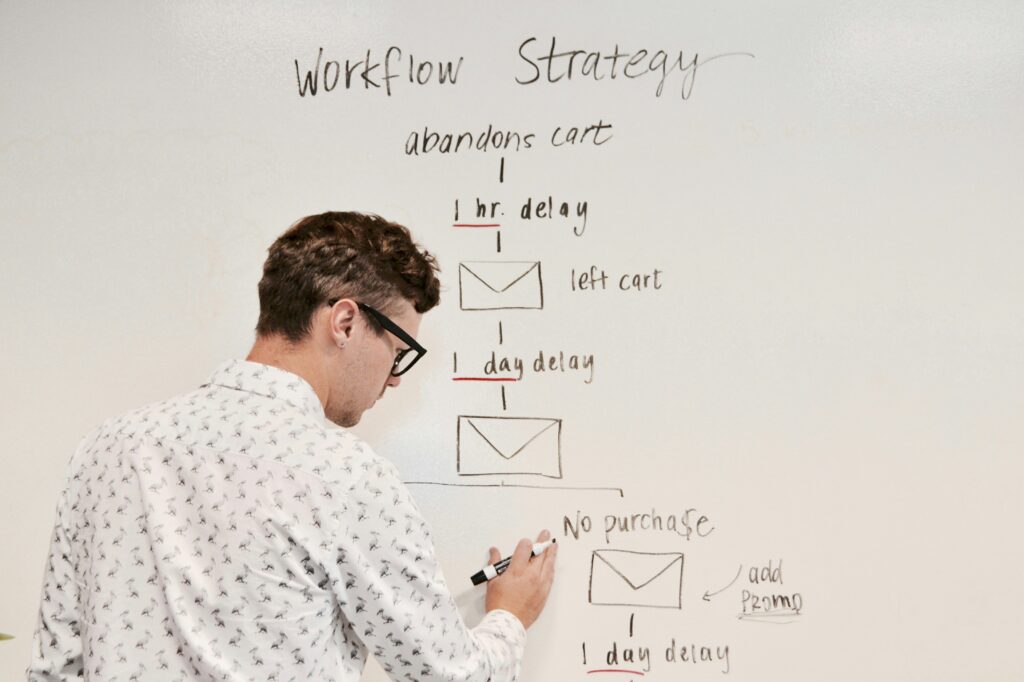
It is not a robot that runs marketing for you. It is a set of rules you define — if this happens, then send that — executed against the behaviour of people on your list. The rules are yours; the execution is automatic.
The system collects signals from each interaction: pages visited, emails opened, links clicked, purchases made. Those signals become the conditions that decide what each person receives next. The purpose is not primarily to save time. It is to keep a conversation going with more people than anyone could manage by hand.
The distinction worth holding onto is between isolated tools and a connected one. Five tools that do not know about each other produce five partial views of the same person; one platform that joins the email, the CRM and the site behaviour produces one. The second is what makes conditional sequences possible at all.
And the larger the operation, the more this matters — not because small businesses do not benefit, but because the saving scales with how many repetitive conversations exist. At a smaller scale the gain comes from picking the right campaign types first. It does not replace people; it removes the part of their work that was never judgment.
How drip marketing actually works
Three stages, and the first one is where most implementations fail.
Collecting the behaviour
Every contact point produces data: a subscription, a page view, a product viewed, a cart abandoned, an email opened. That record is what the sequences read from, which means a sequence can only be as good as the tracking underneath it.
Site tracking is the part people underestimate. Knowing which pages someone visited before they wrote to you changes what the first message should say, and without it every sequence starts from the same assumption about everybody.
Workflows and real personalization
A workflow is if-this-then-that with a clock attached. If someone downloads a guide, send four emails over seven days; if they click the pricing link in the second one, skip to the sales sequence; if they open nothing, stop after the third.
Personalization is not inserting a first name. It is content that changes based on purchase history, location, or which stage of the relationship someone is in. The name in the subject line is the least sophisticated version of this and the one most often mistaken for the whole thing.
Segmentation then happens continuously rather than as a monthly task. Someone who clicks a specific link moves into one group; someone who ignores three consecutive emails moves into another, and the sequence each receives differs accordingly.
Most platforms now provide a visual canvas for mapping this — the path from first contact through purchase and repeat purchase, laid out as a diagram. The visual version matters less for building than for explaining: it is what gets the rest of the company to understand what is running.
Data quality decides the outcome. If the contact records are incomplete or duplicated, automation amplifies the mess rather than organizing it. Cleaning the list before automating is unglamorous and it is the step that determines whether any of this works.
A welcome sequence is the usual first build, because the trigger is unambiguous and the audience is paying attention. It is also the one where results appear fastest, which matters for getting the rest approved.
What you actually get from it
Four effects, and they are worth separating because they justify different amounts of setup.
Personalization at a scale a person cannot reach
Each contact can receive messages shaped by what they actually did rather than by what the average contact does. That is not a marginal improvement over a broadcast: it is a different kind of message, and the relevance is what the recipient notices.
Hours back, in the places they were being lost
The time recovered comes from a specific place: the follow-up emails, the list exports, the manual sends that happen the same way every week. Automating a task that occurs once a quarter returns nothing. Automating one that occurs forty times a week returns a working day.
Being able to attribute a sale to a campaign
With manual sending, knowing which message produced which sale is close to impossible. With sequences, the path is recorded, which means the decision about what to do more of stops being a matter of opinion.
Fewer of the errors that embarrass you
No more copying lists between tools, which is where the wrong message reaches the wrong person. That failure mode costs more than its frequency suggests, because the people who notice are the ones paying attention.
There is also an internal effect that gets overlooked: sales, marketing and support all read from the same record. Somebody in support can see that a customer is mid-sequence, which prevents the conversation where the company appears not to know its own customer.
What none of this does is create demand. Sequences work on people who already raised a hand. A business without a way to generate that first signal will automate an empty funnel very efficiently.
Tools, and what to look for
The platform matters less than the sequence design, with one exception covered below. Four capabilities are the minimum.
The capabilities that are not optional
Whatever else a platform offers, these four decide whether it can do the job:
- Email sequences with conditions: not just scheduled sends, but branching on what the recipient did.
- Lead scoring: a way to rank contacts by how close they are to buying, so sales talks to the right ones.
- More than one channel: email as the base, with the ability to add messaging or ads to the same sequence.
- Reporting that shows the sequence, not just the send: which step people leave at is the number that improves things.
Integration with the CRM
This is the exception, and it is the most consequential technical decision here. If the automation tool does not sync cleanly with wherever customer records live, you will spend your time reconciling two versions of the same contact. That work never ends and it never produces anything.
The options, by size of operation
Roughly three tiers, and picking from the wrong one is the usual cause of migrating within a year:
- Enterprise suites (Salesforce Marketing Cloud, Oracle, Adobe): built for large organizations with dedicated teams. The implementation cost exceeds the licence cost.
- Mid-market all-in-one (HubSpot and similar): the email, CRM and site tracking in one place, which is the configuration most growing companies actually need.
- Entry-level (Mailchimp, Brevo and similar): enough for a welcome sequence and a cart recovery, with a free tier to find out whether you will use it.
Social scheduling tools sit alongside rather than inside this. They publish, listen for brand mentions and consolidate replies, and they are a separate purchase from the sequence engine.
Conversational tools — chat widgets and automated agents — handle first-contact questions around the clock and hand over when the question needs a person. Worth adding once the volume of repeated questions justifies it, and premature before that.
Choosing a platform without getting trapped
Five criteria, in the order they will actually matter.
Ease of use first, and it is not a soft consideration. If building a sequence requires a two-week course, the team will not build sequences. A visual builder that a marketer can learn in an afternoon is worth more than a feature list nobody reaches.
Then how it scales — specifically how the price scales. Most platforms bill by contacts stored rather than emails sent, so a list that grows while engagement does not becomes an increasing bill for no additional return. Ask what the invoice looks like at five times your current list.
Then integration: the CRM, the store, the analytics. Anything that needs manual export is a step that will be skipped within a month.
Then support, which matters at a specific moment — when a live sequence is misfiring and the answer is needed in hours rather than days. Check the response time commitment, and check whether support exists in the language your team works in.
And finally the analysis and personalization features, which is where the actual work happens: segmenting on behaviour, building content that varies, and seeing conversion by step rather than only by campaign.
One question is worth asking any vendor before signing and almost nobody asks it: how do contacts, tags and engagement history come out if you leave? A platform you can exit is a reversible decision. One you cannot is a dependency, and the difference does not appear in any comparison table.
How this looks in different industries
The mechanics are the same everywhere; what changes is which trigger is worth building around.
Ecommerce: recovering carts and keeping customers
Cart abandonment is the highest-return sequence in retail, because the intent already existed and something interrupted it. A short series — a reminder, then a reason, then an incentive — recovers a meaningful share of what would otherwise be lost. The discount belongs in the last message rather than the first, so you are not paying for the people who would have returned anyway.
Product recommendations based on browsing history work on the same principle: the signal already exists, and the sequence uses it rather than guessing.
Financial services: acquisition and cross-selling
Banks and insurers automate around dates in the contract. A term deposit approaching maturity triggers a renewal offer before the customer starts looking elsewhere, which is a sequence whose timing is determined by data the institution already holds.
Cross-selling runs the same way: someone who insures a car enters a sequence offering home, life or travel cover, paced according to their profile rather than sent on the same day to everyone.
Property: following up on enquiries
Agencies automate the follow-up from the first click on a listing: relevant properties, an invitation to view, and a post-viewing follow-up — with an agent stepping in at the point where a person adds something a sequence cannot.
The pattern common to all three is identifying the moment someone is most receptive and arriving then. That timing is what the automation buys; the message itself is usually something a person could have written.
One caution about the published results in this field: the impressive percentages that circulate are rarely sourced, and the ones that are usually come from the vendors selling the software. Measure your own sequences against what you were doing before, which is the only comparison calculated on your own customers.
Where AI is changing this, and where it is not
Generative AI has lowered the cost of producing variants to something close to zero, which changes what is economically sensible rather than what is possible.
Variants at a cost that makes segmentation worthwhile
Writing six versions of a message for six segments used to be a reason not to segment. That constraint has largely gone, which means granular campaigns now cost roughly what a generic one costs. The limit has moved from production to judgment: deciding which segments are worth separating at all.
Models that adjust the scoring themselves
Lead scoring is the application where machine learning earns its place. Rather than maintaining rules by hand, the model learns which behaviours preceded past conversions and reweights accordingly. It is unglamorous and it removes a maintenance task nobody enjoyed.
Predictive work, and the honest limits
Predicting which customers are about to leave, and triggering retention before they do, is genuinely useful where there is enough history to learn from. On a small list it produces confident predictions from insufficient data, which is worse than no prediction.
Most platforms now include an assistant for drafting messages and chat scripts. Some of this produces measurable results today and some of it is positioning; the way to tell the difference is whether the feature changes a number you were already tracking.

Practices that decide whether it works
Five, and the first one is the one that separates projects that work from projects that get abandoned.
Define the objective in numbers, before touching a tool
“Increase qualified leads by thirty percent in ninety days” is an objective. “Automate our marketing” is a budget request. The first tells you which sequence to build and when to stop; the second guarantees a year of configuration with nothing to show.
Segment on behaviour, not demographics
The segments that matter describe what people did. “Opened the last five emails and bought nothing” is a segment worth writing to; “women aged 25 to 34” usually is not, because it predicts almost nothing about what someone wants next.
Bring the other departments in early
Sequences affect sales, support and sometimes finance. Building them without those teams produces automation that contradicts what customers are told elsewhere. A diagram anyone in the company can read is worth the hour it takes to draw, mostly because it is what gets the resources approved.
Watch it, and keep adjusting
A dashboard you check for five minutes each morning catches a misfiring sequence before it has run for a week. The two most common failures are launching without testing the flow end to end, and automating so much that the correspondence stops sounding like a person wrote it.
The working method is small and iterative: launch one sequence, measure it, adjust it, scale what worked, and switch off what did not without waiting for it to improve. Most of the gain comes from the second and third iteration rather than from the initial build.
| Practice | What it prevents |
|---|---|
| A numeric objective | Configuring indefinitely with nothing to measure |
| Behavioural segments | Writing to a demographic that wants different things |
| Early involvement of other teams | Automation that contradicts what support says |
| A daily dashboard check | A broken sequence running for a week |
| Small launches | Building a complex flow nobody validated |
None of these is about the software. They are about deciding what the sequences are for, which is the part that cannot be bought.
Whether a team will actually use it
Adoption is the risk nobody budgets for. A platform the team avoids is more expensive than no platform, because the subscription continues while the work goes back to being manual.
Visual builders, and why they matter
Building a flow by dragging blocks on a canvas, with no code, is now standard. It is not a convenience feature: it is the difference between a team adopting the tool in a week and quietly abandoning it because it felt like engineering.
The test before buying is to have the person who will actually use it build one simple sequence during the trial. If they cannot, no amount of capability further down the feature list will rescue it.
Training and support as part of the product
Documentation, onboarding and support in the language the team works in are part of what you are buying. A vendor whose help centre exists only in English, for a team that does not work in English, has effectively sold a product without instructions.
Setup assistants that break the configuration into steps help more than they appear to, because they turn one intimidating task into six ordinary ones.
One platform or five
Consolidating email, social, CRM, the pages that collect the addresses and analytics into one tool reduces management time and the learning curve, at the cost of being better at some of those jobs than others. For a small team the consolidation usually wins; for a specialist team it usually does not.
Templates are worth using as a starting point rather than as a finished product. They save the hours of initial configuration and they produce sequences indistinguishable from every other company using the same template, so the editing is not optional.
Where this leaves you
Drip marketing is the only part of marketing that keeps working while nobody is looking at it. That is its whole advantage, and it is why the setup is worth more care than the volume of messages it will send.
The returns quoted for this category are mostly unsourced and mostly come from vendors. What is defensible is narrower and more useful: a sequence that reaches someone at the moment they were deciding outperforms the same message sent on a schedule, and that gap is measurable against your own baseline within a quarter.
The practical starting point is one sequence rather than a system. A welcome series if you have a list, or a cart recovery if you sell online. Build it, measure it against what happened before it existed, and let that result decide whether the second one gets built. Where automated follow-up sits in the wider plan is the question that comes after.
Frequently asked questions
What is drip marketing?
A planned series of messages triggered by what someone does rather than by a date. Someone subscribes, abandons a cart or views a product, and the follow-up runs automatically according to rules set in advance.
Which tools do you need?
At minimum an email platform that supports conditional sequences, somewhere customer records live, and the connection between the two. Everything else is useful later.
How do you choose a platform?
Judge ease of use first, then how the price scales with your list, then whether it integrates with your CRM without manual exports. And ask how contacts and history come out if you leave, which is the only irreversible part of the decision.
Which industries benefit most?
Ecommerce, financial services and property, because each has an unambiguous trigger: an abandoned cart, a contract date, an enquiry about a specific property. Any business with a repeated trigger qualifies.
What does AI change here?
It makes producing message variants nearly free, so segmenting finely now costs about what a generic campaign costs. It also improves lead scoring by learning from past conversions instead of relying on hand-maintained rules.